Human perception is an interesting thing.
When I put clean forks in the kitchen drawer, I like to sort them so that forks of the same size go together. And yes, I realize not everyone obsesses about categorizing stuff to the degree that I do.
We have the following types of forks that we use regularly.
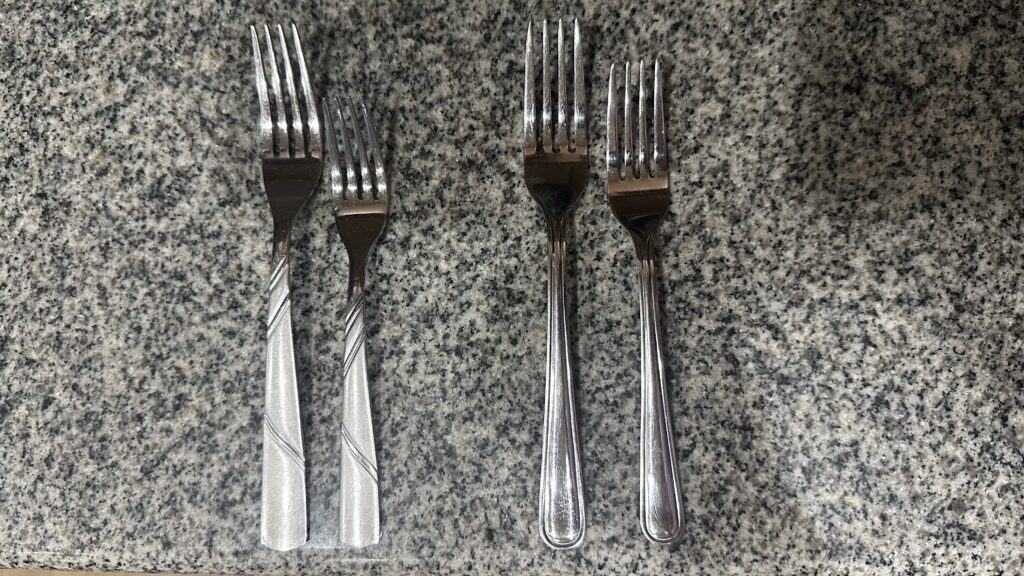
You’ll notice that each style of fork comes in big and smaller sizes.
Here’s the interesting thing. The second fork in the picture is about 86% the size of the first. The fourth fork is about 92% the size of the third. And the relative sizes make a difference!
Without paying much attention, I can easily separate the first and second forks. I quickly place each where it belongs. Not so with the third and fourth forks! When I’m not careful, I sometimes put these forks in the wrong pile! (Don’t worry! I immediately fix the mistake when it happens.)
So, what’s going on here?
I can easily differentiate the size of objects when one is less than 86% of the size of another. I need to pay more attention to differentiate the size of objects when one is greater than 92% of the size of another.
The percentages may vary from person to person. They may change as we age. But I think most people can relate to the phenomenon. It’s a bit like the fact that we do not need to count a small number of objects. If there are three forks next to each other on a table, you can immediately see that there are three. You don’t need to count each one to be sure. Not so if there are 32 forks next to each other! To be sure, you need to count those 32 forks.
“We have to remember that what we observe is not nature herself, but nature exposed to our method of questioning.”
— Werner Heisenberg
The way we perceive the world is fascinating!
Leave a Reply